In short
No, you cannot drop the final editor: AI can prepare a large part of a subtitle file, but a person still makes the last pass. Editors still change things in AI-prepared files, and those changes are often small. That is why Undertitle attaches a report to each subtitle file. Cue duration, reading speed, line length, and lines per cue are four of the parameters in that report.
Teams that buy subtitling used to choose between AI subtitling and manual subtitling. That is no longer the real choice. AI now does much of the groundwork, and a person still finishes the file. The useful question is narrower. Once AI has prepared the file, can the last person go?
What can AI prepare?
A lot. AI can produce the transcript, the translation, the timing, and the line breaks of a first subtitle file. That first file is now the starting point.
Television and on-demand providers are moving that way. Ofcom is the communications regulator in the United Kingdom. Its Television and on-demand programme services: Access services report, January to December 2025 says providers are increasingly exploring automated and AI-assisted subtitling tools, to deal with cost and capacity pressures. The researchers behind Human- or machine-translated subtitles: Who can tell them apart? describe machine translation that a person then edits as common practice in subtitling. That is their reading of the field, not a survey.
So the preparation can be automated. The finish is a different step.
Why does the final edit stay?
Because the documents that shape professional subtitling still rely on human judgement, and the newest one says so about AI directly.
Ofcom, the communications regulator in the United Kingdom, published its Television and on-demand programme services: Access services report, January to December 2025 on 26 May 2026. In it, Ofcom wrote that AI-assisted subtitling tools need careful assessment and ongoing human oversight to ensure quality. That is Ofcom's statement in a report. It is not a new rule with a number attached.
The older documents point the same way. Read them for what they say, and for what they do not.
| Document | What it says | What it does not say |
|---|---|---|
| Code of Good Subtitling Practice, 1998 | Each production should be edited by a reviser or editor. | Anything about AI. It is older than these tools. |
| Paragraph 2.14 of Ofcom's Guidelines on Providing Television and On-Demand Access Services | New technology should not lower the quality of subtitles and other access services. Providers should assess it against the guidelines. | That automation is forbidden. |
| Paragraph 2.29 of the same guidelines | Good subtitles take expertise and case-by-case judgement, from people who are appropriately trained. | That a second editor must follow an AI pass. |
| Paragraph 2.30 of the same guidelines | Providers should review subtitle quality for pre-recorded content before transmission, and again after it. | That the review must be done by a person. |
| British Broadcasting Corporation Subtitle Guidelines | Hard rules cannot cover every situation. The result depends on the content, the genre, and the subtitler's expertise. | That an automated first pass is forbidden. |
Research gives the same answer, within its limits. The 2026 study Quality and Comprehensibility of Interlingual Subtitles Produced by Humans or with Machines tested one eight-minute video. It compared English-to-German subtitles from three public web tools with subtitles made by people. The authors concluded that automatically generated subtitles cannot yet deliver broadcast-ready quality without human intervention. They also note that more dedicated systems may do better.
A machine check of the finished file does not close the gap either. The README of the British Broadcasting Corporation's subtitle file validator says a technical check is no substitute for previewing the subtitles against the programme. It also says such a check cannot confirm that editorial guidelines were met. A single accuracy score has the same blind spot, as Why Word Error Rate Is the Wrong Measure for Subtitles explains.
Key point
AI can prepare a subtitle file. A person still makes the final edit. For now, that step stays.
Do editors still change an AI-prepared file?
Yes. In our work, final editors still make changes to files that AI prepared. Those changes are often small. They are not zero. We do not quote a share of lines changed.
Small does not mean unimportant. The viewer sees the file the editor signed off, not the file the machine prepared. One wrong word is a small change. On screen, it is still a wrong word.
That is the real difference between the two ways of working. AI prepared it. A person signs it off.
What does the Undertitle report do?
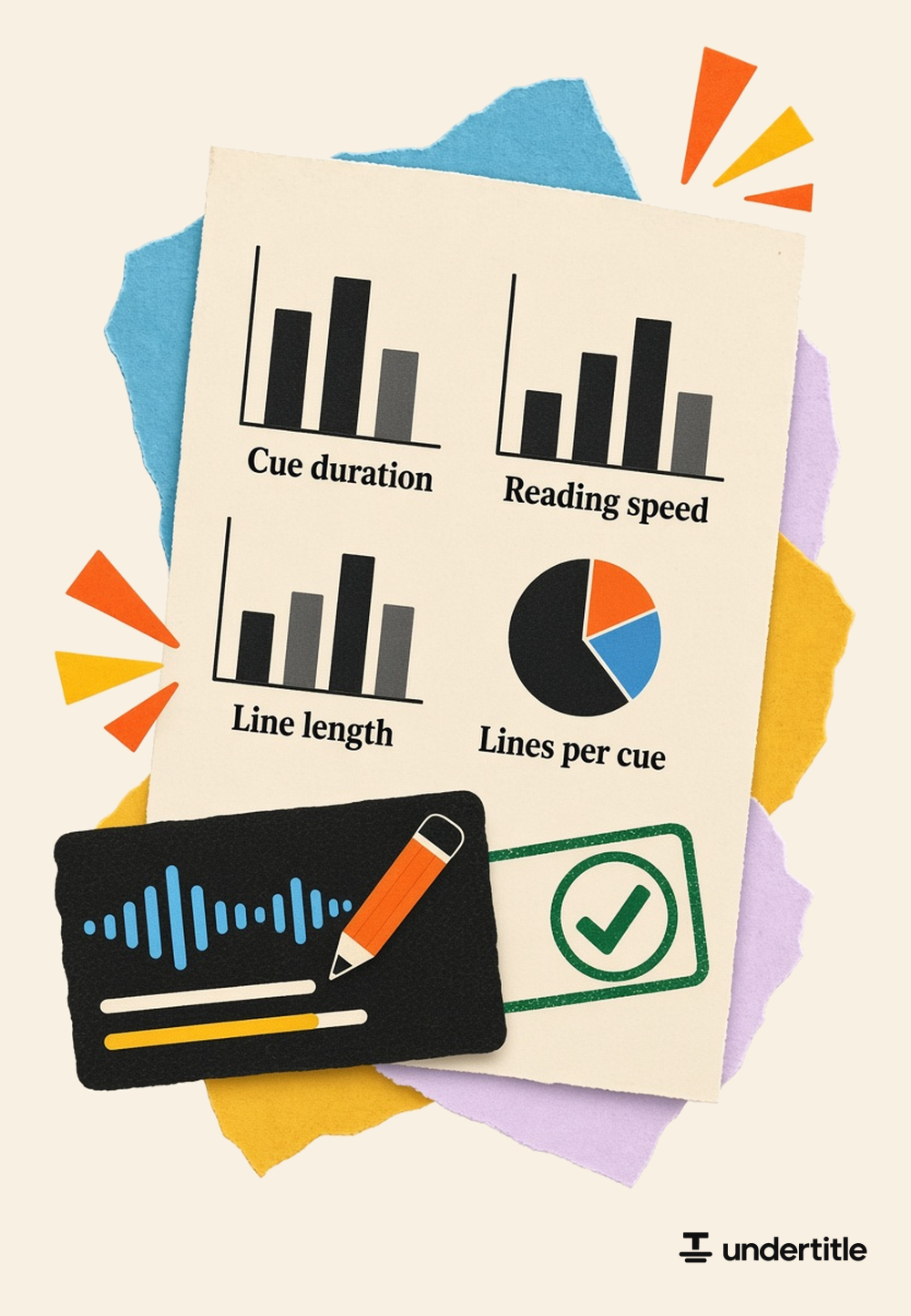
It measures the subtitle file. Undertitle attaches the report to every subtitle file it delivers. The report does not list lines or notes. It shows numbers. Cue duration, reading speed, line length, and lines per cue are four of the parameters in the report.
| Parameter | What it measures |
|---|---|
| Cue duration | How long each cue stays on screen, in seconds |
| Reading speed | How fast each cue asks the viewer to read, in characters per second |
| Line length | How long each line is, in characters |
| Lines per cue | How many cues have one line, two lines, or three or more lines |
Those four are not the whole report. It also records how many cues are in the file, the shortest and the longest cue, and the limits that applied when the file was made: the minimum and maximum time a cue may stay on screen, the maximum characters on a line, and the comfortable reading speed. For cue duration, reading speed, and line length it stores the minimum, the maximum, the mean, the median, and the 95th percentile, and it lists the cues that sit outside the usual range.
The median is the middle value. The 95th percentile shows the high end: at most one value in twenty sits above it.
The editor still makes the last changes. The charts give them a view of the whole file before they start. If reading speed or line length runs high, they see it in the numbers. They still watch the subtitles with the picture and decide what to change.
The report does not replace the last pass. It gives the editor the numbers before that pass starts.
Where does Undertitle fit?
Undertitle makes professionally timed subtitles for shows and films, for broadcasters, streamers, distributors, and localization teams. AI does the preparation. Your editors keep the final say, and the report gives them the numbers on each file.
Undertitle can supply both closed and open subtitles. Captions for deaf and hard-of-hearing viewers are planned and will be available soon.
The clearest test is your own material. Try Undertitle on a short clip and see what the report shows your editor.
Frequently asked questions
01
Can AI subtitling replace the final subtitle editor?
No. AI can prepare a large part of a subtitle file, but a person still makes the final edit. In its Television and on-demand programme services: Access services report, January to December 2025, published on 26 May 2026, Ofcom, the communications regulator in the United Kingdom, wrote that automated and AI-assisted subtitling tools need careful assessment and ongoing human oversight to ensure quality.
02
Do editors still change subtitles that AI prepared?
Yes. Final editors still make changes to AI-prepared subtitle files. Those changes are often small, but they are not zero. One wrong word is a small change. On screen, it is still a wrong word. Undertitle does not quote a share of lines changed.
03
What is in the Undertitle report?
Undertitle attaches one report to each subtitle file it delivers. Cue duration, reading speed, line length, and lines per cue are four of the parameters. The report also stores the number of cues, the shortest and the longest cue, and the limits used for that file: the minimum and maximum cue duration, the maximum characters on a line, and the comfortable reading speed. For cue duration, reading speed, and line length it stores the minimum, the maximum, the mean, the median, and the 95th percentile, and it lists the cues that sit outside the usual range. The report measures the file. It does not list lines or notes. The editor still makes the last changes.
04
Does a law require a person to edit every subtitle file?
No law in our research says that. The guidelines of Ofcom, the communications regulator in the United Kingdom, ask for quality review, not for a signature on every file. Paragraph 2.30 of Ofcom's Guidelines on Providing Television and On-Demand Access Services says providers should review the quality of subtitles for pre-recorded content before transmission and again after it. The professional norm is older and stricter: the Code of Good Subtitling Practice of 1998 says each production should be edited by a reviser or editor.
05
Can an automatic file check replace the final edit?
No. The README of the British Broadcasting Corporation's subtitle file validator says a technical check of a subtitle file is no substitute for previewing it against the programme, and that it cannot confirm editorial or presentation guidelines were met. A person watching the subtitles with the picture still does that.
Book a free demo
Want to see how Undertitle turns English shows and films into Dutch subtitles? We will walk through it with you.