In short
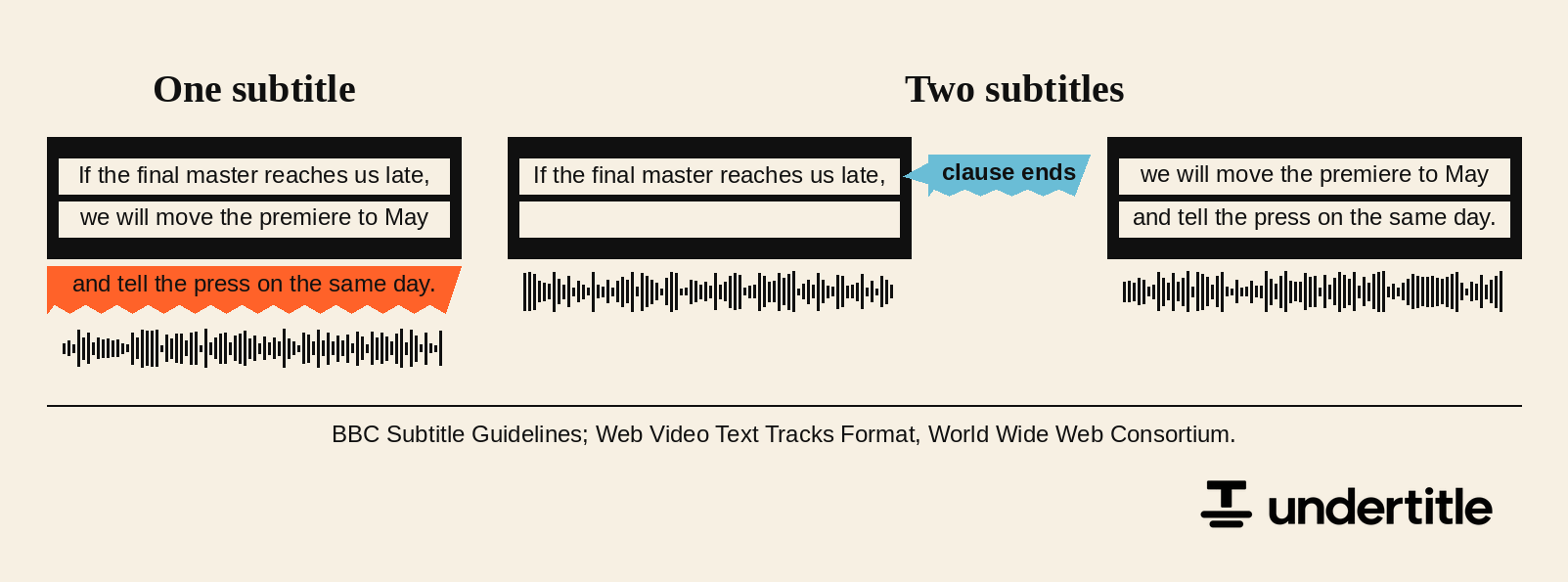
One subtitle becomes two where a unit of meaning ends: ideally at the end of a sentence, and in a long sentence at the end of a clause. Wrapping text onto a second line does not create a new subtitle. The Vlaamse Radio- en Televisieomroeporganisatie splits between a main clause and a subordinate clause, or after a word group, in its Stijlboek T888, and Netflix splits at clause level in its Timed Text Style Guide: Subtitle Templates.
What counts as one subtitle?
One subtitle is one timed cue: a piece of text with its own start time and end time. It can hold one line or two.
The WebVTT: The Web Video Text Tracks Format specification from the World Wide Web Consortium defines a cue as one piece of time-aligned text, "for example one subtitle." The text of a cue may contain line breaks. A line break does not start the next cue. The next cue is a new block with its own times.
Netflix draws the same line in its Timed Text Style Guide: Subtitle Templates. It calls the timed unit a subtitle event, and it treats the lines inside that event in a separate section. That is Netflix's house rule for its own deliveries, not a law.
So one subtitle becomes two when the next words get their own start and end time. Wrapping text onto a second line does not do that. A transcript has no such cues until someone splits and times it. A transcript is not a subtitle covers that difference.
Where should one subtitle end?
At the end of a unit of meaning. Ideally that is the end of a sentence. When a sentence is too long for one subtitle, it is the end of a clause.
The guides a subtitle editor in Belgium works with say this in different words:
| Guide | Whose rule | Where one subtitle ends |
|---|---|---|
| Normen en instructies voor open ondertiteling | Vlaamse Radio- en Televisieomroeporganisatie, open subtitles | When a sentence runs over more than one subtitle, each subtitle is a grammatical unit, for example a main clause and a subordinate clause. That rule does not apply when the dialogue has a noticeable pause. |
| Stijlboek T888 | Vlaamse Radio- en Televisieomroeporganisatie, closed subtitles on teletext page 888 | At a logical place: between a main clause and a subordinate clause, or after a word group. |
| Charte relative à la qualité des mesures d'accessibilité, article 8 | Conseil supérieur de l'audiovisuel de la Communauté française, for programmes that are not live or near-live | When a sentence runs over more than one subtitle line, the split respects units of meaning, punctuation, and logic. |
| Timed Text Style Guide: Subtitle Templates | Netflix, for its own deliveries | At clause level. |
| Code of Good Subtitling Practice | Endorsed by the European Association for Studies in Screen Translation in 1998 | In sense blocks or grammatical units. Ideally each subtitle is syntactically self-contained. |
Key point
A subtitle ends where a unit of meaning ends, ideally the sentence and otherwise the clause. It does not end where the line runs out of room.
The two style books of the Vlaamse Radio- en Televisieomroeporganisatie are written for Dutch-language subtitles. The charter of the Conseil supérieur de l'audiovisuel de la Communauté française addresses television editors in the French-speaking community. Netflix and Amazon Prime Video set house rules for the subtitles delivered to them.
Flemish media also share one standardised style book, in force since 15 July 2025, according to the answer of the Flemish minister for Media to written question 32 of 23 December 2025. That answer lists typeface, colours, position, maximum reading speeds, and shortening. It does not say where a subtitle ends, and no public copy of the style book was found. Ask the broadcaster you deliver to which text applies.
When is a sentence too long for one subtitle?
When it needs more lines than one subtitle allows. The limits in these guides are not the same:
- Amazon Prime Video's Localization and Technical Style Guides, September 2026: no more than two lines per subtitle event, and no more than 42 characters per line. The English guide covers the United States and the United Kingdom. There is no separate guide for Belgium.
- Netflix's Timed Text Style Guide: Subtitle Templates: 42 characters per line for most languages written in the Latin alphabet.
- The Charte relative à la qualité des mesures d'accessibilité, article 6: ideally two lines. Three lines only in exceptional cases, depending on how fast people speak.
When the sentence needs more lines than that, the next words go into a new subtitle, and the split goes where the first clause ends.
A subtitle can also become two because of time. The Normen en instructies voor open ondertiteling of the Vlaamse Radio- en Televisieomroeporganisatie say to split a subtitle in two, where possible, when it stays on screen too long. Amazon Prime Video's guides list merging or splitting subtitle events as one way to help reading speed. That is a timing question, covered in Reading Speed in Subtitles: How Many Characters per Second Can a Viewer Read?
Is a line break inside one subtitle the same decision?
No. Where the text breaks between the two lines of one subtitle is a separate choice with its own rules, and this article does not cover it.
The guides keep the two apart. The Stijlboek T888 of the Vlaamse Radio- en Televisieomroeporganisatie arranges the two lines of a subtitle in its layout section, and splits a sentence over several subtitles in a separate section. Amazon Prime Video's Localization and Technical Style Guides, September 2026 put line breaks under line treatment: keep a subtitle to one line unless a break is needed for clarification or style, and ideally break at a logical and grammatical point. The English guide adds a list of where a line should and should not break. The Dutch and French guides do not.
The word itself causes confusion. Agnieszka Szarkowska's 2016 Report on the results of an online survey on subtitle presentation times and line breaks in interlingual subtitling. Part 1: Subtitlers uses segmentation for the break between the two lines of one subtitle. This article uses it for the split into a new subtitle.
Why does an automatic split end in the wrong place?
Because the common method in the research counts characters. It does not look for the unit of meaning.
Correct words are only the first step. Karakanta and colleagues write, in Evaluating Subtitle Segmentation for End-to-end Generation Systems (2022), that subtitling has to go beyond automatic transcription, and that full automation needs further steps, including segmentation into readable chunks.
When software makes that split, the research describes a length rule:
- In 2016, Álvarez and colleagues wrote, in Impact of automatic segmentation on the quality, productivity and self-reported post-editing effort of intralingual subtitles, that most automatic solutions in stenotyping, respeaking, or audio transcription could not use natural pauses or syntactic and semantic information. Automatic segmentation was mainly done by the maximum number of characters per line, or by hand. The same paper names the inability to segment subtitle text in a logical way as a major limit of automatic subtitling.
- In 2022, Papi and colleagues wrote, in Dodging the Data Bottleneck: Automatic Subtitling with Automatically Segmented ST Corpora, that automatic segmentation into subtitles is normally done with rules and heuristics, for example by inserting a break before a length limit is reached.
A length rule stops the subtitle where the line is full. The clause may end a few words later. That is the split an editor has to move.
How do you check where each subtitle ends?
Read each subtitle on its own, then ask five questions:
- Does it say one complete thing? If it stops in the middle of a clause, move the split.
- Does it end at the end of a sentence? If not, does it end at the end of a clause, or at least after a word group?
- Does the next subtitle start a new unit, rather than the tail of the last one?
- Is the problem only a wrapped line? Then it is a line-break question inside one subtitle, not a new subtitle.
- Which guide do you deliver against? Check its split rule in the table above. The Flemish style books, the French-community charter, and the streaming house rules do not use the same words.
Where does Undertitle fit?
Undertitle applies the segmentation this article sets out. Each subtitle ends where a unit of meaning ends: the sentence first, then the clause, not the point where a line runs out of room. A line break stays inside the same subtitle. Undertitle follows the guide you choose, from the style books of the Vlaamse Radio- en Televisieomroeporganisatie to the house rules of Netflix and Amazon Prime Video. Your editors keep the final say.
Undertitle can supply both closed and open subtitles. Captions for deaf and hard-of-hearing viewers are planned and will be available soon.
Because Undertitle splits by these rules, your own material is the clearest test. Try Undertitle on a short clip and read where each subtitle ends.
Frequently asked questions
01
What are the basic subtitle segmentation rules?
End each subtitle where a unit of meaning ends, so that it reads as one complete piece. The Vlaamse Radio- en Televisieomroeporganisatie, in its Normen en instructies voor open ondertiteling, says that when a sentence runs over more than one subtitle, each subtitle must be a grammatical unit, such as a main clause and a subordinate clause. That rule does not apply when the dialogue has a noticeable pause. Netflix's Timed Text Style Guide: Subtitle Templates asks for segmentation at clause level.
02
Does a line break create a new subtitle?
No. A new subtitle has its own start and end time. A line break stays inside the same subtitle. The specification WebVTT: The Web Video Text Tracks Format defines a cue as one piece of time-aligned text, for example one subtitle, and the text of that cue may contain line breaks. The next cue is a separate block with its own times.
03
How many lines can one subtitle have?
It depends on the guide. Amazon Prime Video's Localization and Technical Style Guides, September 2026 allow no more than two lines per subtitle event and no more than 42 characters per line. The Charte relative à la qualité des mesures d'accessibilité of the Conseil supérieur de l'audiovisuel de la Communauté française says ideally two lines, and three only in exceptional cases. When the words need more lines than that, they belong in the next subtitle.
04
Is there a Belgian guide for where a subtitle ends?
Yes, on both sides of the language border. The Vlaamse Radio- en Televisieomroeporganisatie splits between a main clause and a subordinate clause, or after a word group, in its Stijlboek T888. The Charte relative à la qualité des mesures d'accessibilité of the Conseil supérieur de l'audiovisuel de la Communauté française asks that a sentence split respect units of meaning. Amazon Prime Video has no separate guide for Belgium in its Localization and Technical Style Guides, September 2026.
05
Why do some guides use the word segmentation for line breaks?
Because the word is used in two ways. Agnieszka Szarkowska's Report on the results of an online survey on subtitle presentation times and line breaks in interlingual subtitling. Part 1: Subtitlers (2016) uses segmentation for how words are placed on the two lines of one subtitle. Netflix's Timed Text Style Guide: Subtitle Templates uses it for how a sentence is split between subtitles. When a guide says segmentation, check which of the two it means.
Book a free demo
Want to see how Undertitle turns English shows and films into Dutch subtitles? We will walk through it with you.