In short
A closed caption appears only when the viewer turns it on, and an open caption is part of the picture and cannot be turned off. That is how EN 301 549 V4.1.1 and Web Content Accessibility Guidelines 2.2 describe the pair. What the text contains is a separate choice. Captions for deaf and hard-of-hearing viewers carry the spoken words plus sounds such as music and who is speaking. A translation carries the dialogue in another language for people who do not understand the original language.
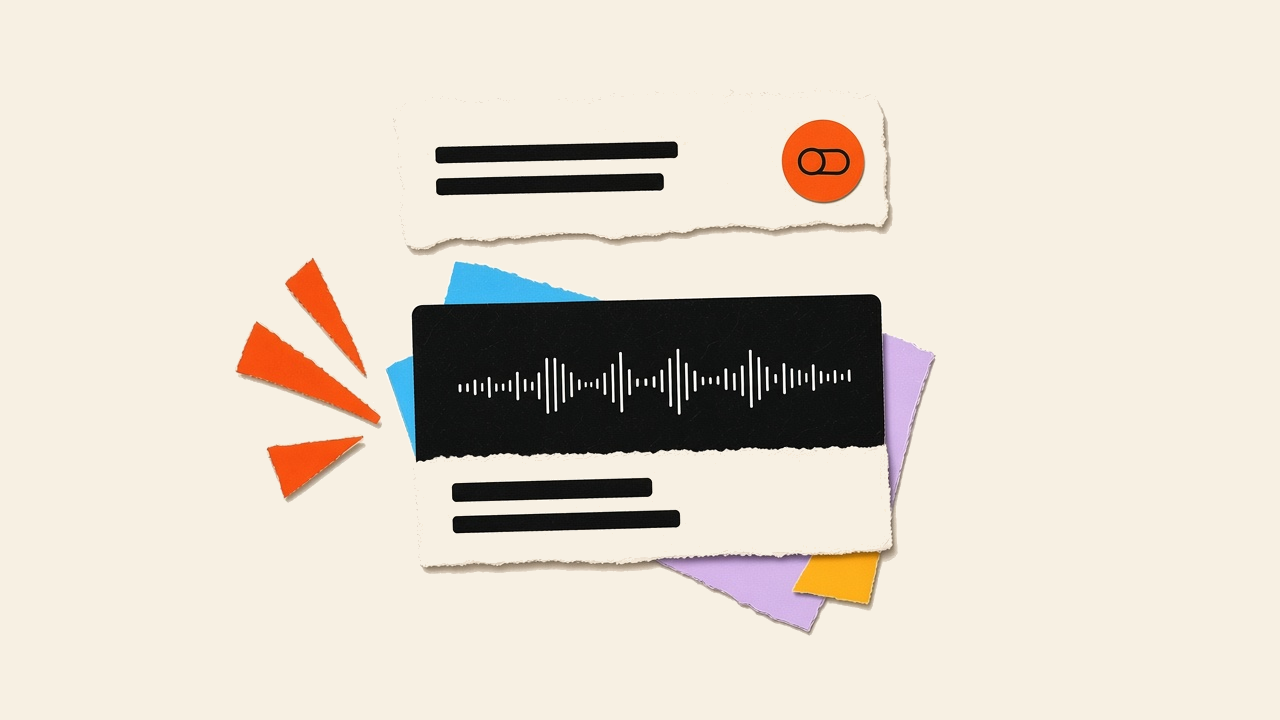
A closed caption appears only when the viewer turns it on. An open caption is part of the picture and stays on screen.
That is one choice. The second choice is what the text says and who it is for: captions for viewers who are deaf or hard of hearing, or a translation for viewers who do not know the language. These two choices are often mixed up. Open or closed says only whether the viewer can switch the text off, not what the text contains. The words "captions" and "subtitles" are often used for both.
What is the difference between open and closed captions?
Closed captions appear only when the viewer chooses to show them. Open captions are part of the video and are always on screen.
The European accessibility standard EN 301 549 V4.1.1 defines the pair. A closed subtitle is shown only in response to user preference. An open subtitle is shown regardless of user preference. Open subtitles cannot be turned off or moved, because they are embedded in the video content.
The standard uses the word "subtitles" here. It says that subtitles for deaf or hard-of-hearing users are also known as captions.
Web Content Accessibility Guidelines 2.2 say the same about captions. Closed captions can be turned on and off with some players. Open captions are captions that cannot be turned off, such as images of text embedded in the video.
| Closed captions | Open captions | |
|---|---|---|
| Can the viewer switch them off? | Yes. They show only when the viewer chooses | No. They are always in the picture |
| Where is the text? | Shown by the player in response to the viewer's choice | Embedded in the video picture |
Key point
Closed captions appear only when the viewer turns them on. Open captions are embedded in the picture and cannot be turned off.
Source: EN 301 549 V4.1.1
What does the text contain, and who is it for?
There are two different texts. Captions for deaf and hard-of-hearing viewers carry the spoken words and the sounds those viewers cannot hear. A translation subtitle carries the dialogue in another language, for people who do not understand the language of the programme.
What do captions for deaf and hard-of-hearing viewers contain?
They contain what is said, who says it, and the other sounds a viewer needs to follow the programme.
Web Content Accessibility Guidelines 2.2 define captions as a text alternative for both speech and non-speech audio needed to understand the media. The glossary says this is what sets captions apart from dialogue-only subtitles. Captions also convey sound effects, music, laughter and who is speaking.
The United States rule for television, 47 CFR § 79.1(j)(2), sets the same aim. Closed captioning must give deaf and hard-of-hearing viewers the audio content in the original language, to the same extent the soundtrack gives it to hearing viewers. Accurate captions include nonverbal information that is not observable, such as the identity of speakers, the existence of music, sound effects and audience reaction. The rule asks for this to the greatest extent the nature of the programme allows.
In Europe, EN 301 549 V4.1.1 says that subtitles made for deaf or hard-of-hearing users are also known as captions or as subtitles for the deaf and hard of hearing. They include information on other parts of the soundtrack that is needed to understand the content.
In the United Kingdom, the Ofcom Code on Television Access Services calls this service "subtitling". Paragraph 3.1(a) defines it as text on screen that represents speech and sound effects, suitable for people with hearing loss and d/Deaf people.
What does a translation subtitle contain?
It contains the dialogue, translated into another language, for people who do not understand the language of the programme.
EN 301 549 V4.1.1 calls these "interlingual subtitles". They translate the original audio into a different language, so that people who do not understand the original language can follow the content.
The Web Accessibility Initiative of the World Wide Web Consortium describes the difference on its Captions/Subtitles page. In its words, translation subtitles are usually only the spoken audio, for people who can hear the audio but do not know the language. The same page says they can also translate the caption text, including the non-speech sounds. It adds that captions are needed for accessibility, while subtitles in other languages are not directly an accessibility accommodation.
On that reading, a translation and captions for deaf and hard-of-hearing viewers are two different jobs.
| Captions for deaf and hard-of-hearing viewers | Translation subtitles | |
|---|---|---|
| Who reads it | Viewers who are deaf or hard of hearing | People who do not understand the language of the programme |
| Language | Same language as the programme | Another language |
| Spoken words | Yes | Yes, translated |
| Who is speaking | Yes | Usually not |
| Music | Yes | Usually not |
| Sound effects | Yes | Usually not |
| Audience reaction | Yes | Usually not |
| Name in EN 301 549 V4.1.1 | Subtitles for the deaf and hard of hearing, also known as captions | Interlingual subtitles |
"Yes" means the sound is included where the viewer needs it to follow the programme. "Usually not" follows the Web Accessibility Initiative's wording that translation subtitles are usually only the spoken audio, and that a translation can include those sounds when it translates the caption text.
Does open or closed decide which text you get?
No. Open or closed only says whether the viewer can switch the text off. It does not say what the text contains.
EN 301 549 V4.1.1 says subtitles may be open or closed. The Web Accessibility Initiative's Captions/Subtitles page says most captions are closed, and that they can also be open. A United States federal glossary, Definitions for Key Accessibility Features for Digital Audiovisual Content, says subtitles for a hearing audience can be delivered as closed or open captions.
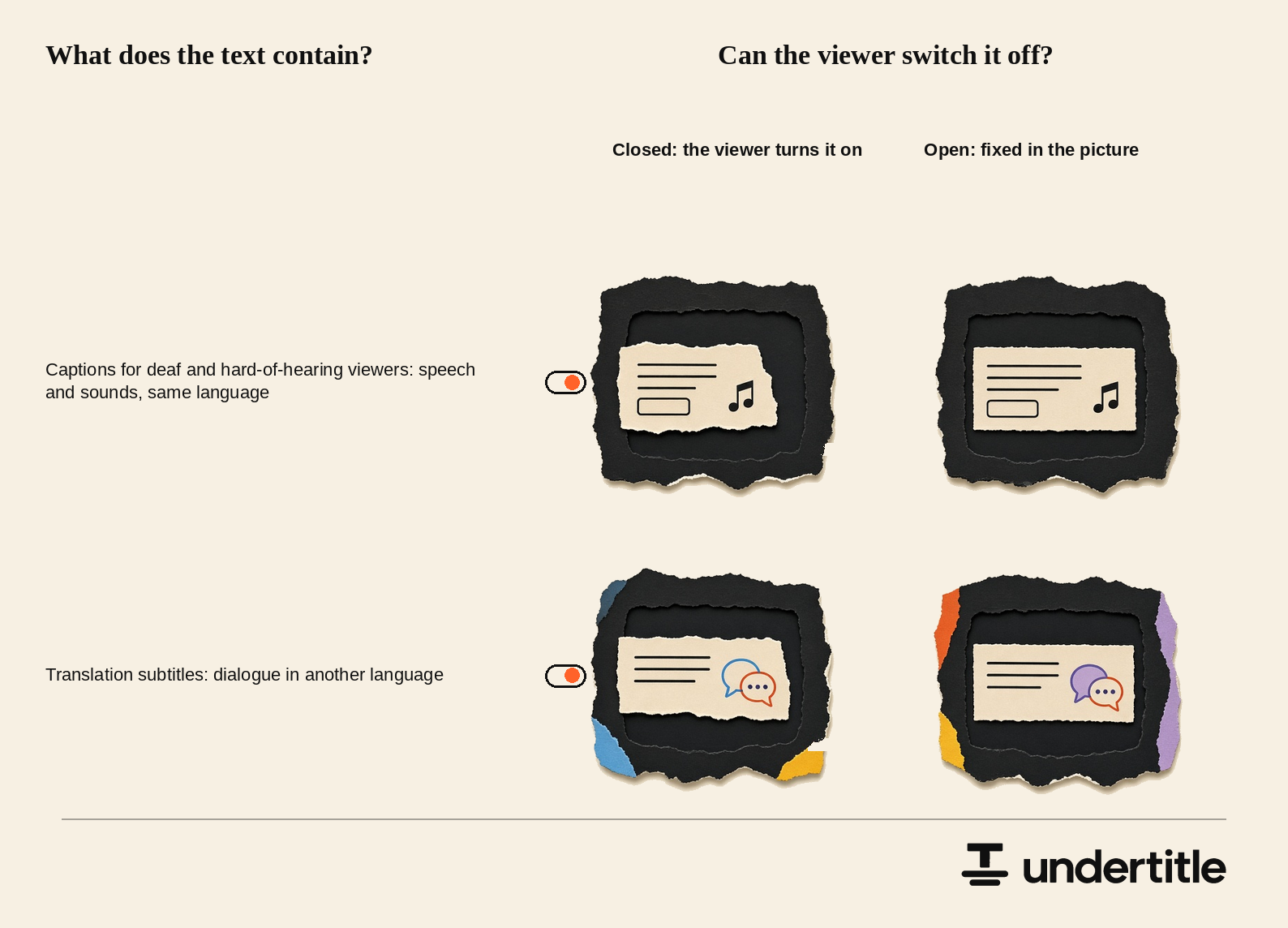
The same words can be burned into the picture or delivered as text the viewer switches on. That gives four combinations:
- Closed captions for deaf and hard-of-hearing viewers. Speech and sounds in the programme language. The viewer turns them on.
- Open captions for deaf and hard-of-hearing viewers. The same text, fixed in the picture for every viewer.
- Closed translation subtitles. The dialogue in another language. The viewer turns them on.
- Open translation subtitles. The same translation, fixed in the picture for every viewer.
The words alone do not tell you which text is meant. EN 301 549 V4.1.1 notes that outside North America, "subtitles" is often used to mean closed captions. Web Content Accessibility Guidelines 2.2 note that some countries call captions subtitles. The European Broadcasting Union uses one word, subtitling, for the service for deaf and hard-of-hearing viewers and for foreign-language translation, in European Broadcasting Union Recommendation R 110.
If you deliver in the European Union, our guide to the European Accessibility Act and subtitles explains what that law asks of subtitles once they reach the viewer.
Undertitle supplies closed subtitles. Captions for deaf and hard-of-hearing viewers are planned and will be available soon.
Frequently asked questions
01
Can viewers turn off open captions?
No. EN 301 549 V4.1.1 says open subtitles cannot be turned off or moved, because they are embedded in the video content. Web Content Accessibility Guidelines 2.2 describe open captions as captions that cannot be turned off. If the viewer must be able to hide the text, use closed captions.
02
Are closed captions the same as subtitles?
It depends on where you are. EN 301 549 V4.1.1 notes that outside North America, "subtitles" is often used to mean closed captions. Web Content Accessibility Guidelines 2.2 also note that some countries call captions subtitles. In that glossary, captions differ from dialogue-only subtitles because they also convey sounds such as music, sound effects, laughter and who is speaking.
03
Are subtitles for the deaf and hard of hearing open or closed?
They can be either. EN 301 549 V4.1.1 says subtitles for deaf or hard-of-hearing users are also known as captions or as subtitles for the deaf and hard of hearing. The same standard says subtitles may be open or closed. Whether the viewer can switch them off is a separate choice from what the text contains.
04
Do captions for deaf and hard-of-hearing viewers include music and sound effects?
Yes, where the sound is needed to follow the programme. Web Content Accessibility Guidelines 2.2 say captions convey non-dialogue audio, including sound effects, music, laughter and who is speaking. The United States rule 47 CFR § 79.1(j)(2) lists the identity of speakers, the existence of music, sound effects and audience reaction, to the greatest extent the nature of the programme allows.
05
Is a translation subtitle the same as captions for deaf and hard-of-hearing viewers?
No. EN 301 549 V4.1.1 calls a translation "interlingual subtitles": text that translates the original audio for people who do not understand the original language. The Web Accessibility Initiative of the World Wide Web Consortium, on its Captions/Subtitles page, says translation subtitles are usually only the spoken audio, and that subtitles in other languages are not directly an accessibility accommodation.
06
Does the European Accessibility Act mention open or closed captions?
No. The European Accessibility Act, Directive (EU) 2019/882, does not define caption, closed caption or open caption. Annex I requires services that give access to audiovisual media services to transmit access components, such as subtitles for the deaf and hard of hearing, in full, in sync with sound and video, while allowing for user control of their display and use.
Book a free demo
Want to see how Undertitle turns English shows and films into Dutch subtitles? We will walk through it with you.