In short
There is no single number. The published norms that count characters differ by language, audience, and type of show. VRT, the Flemish public broadcaster, sets an ideal of 12 characters per second in its Normen en instructies voor open ondertiteling. Netflix allows up to 20 for adult titles in its English (USA) Timed Text Style Guide. Research does not settle it either. In the eye-tracking study Viewers can keep up with fast subtitles: Evidence from eye movements (PLOS ONE, 2018), viewers understood subtitles just as well at 20 characters per second as at 12. So your house style sets a target for each language and audience and checks every subtitle against it.

What does reading speed measure in a subtitle?
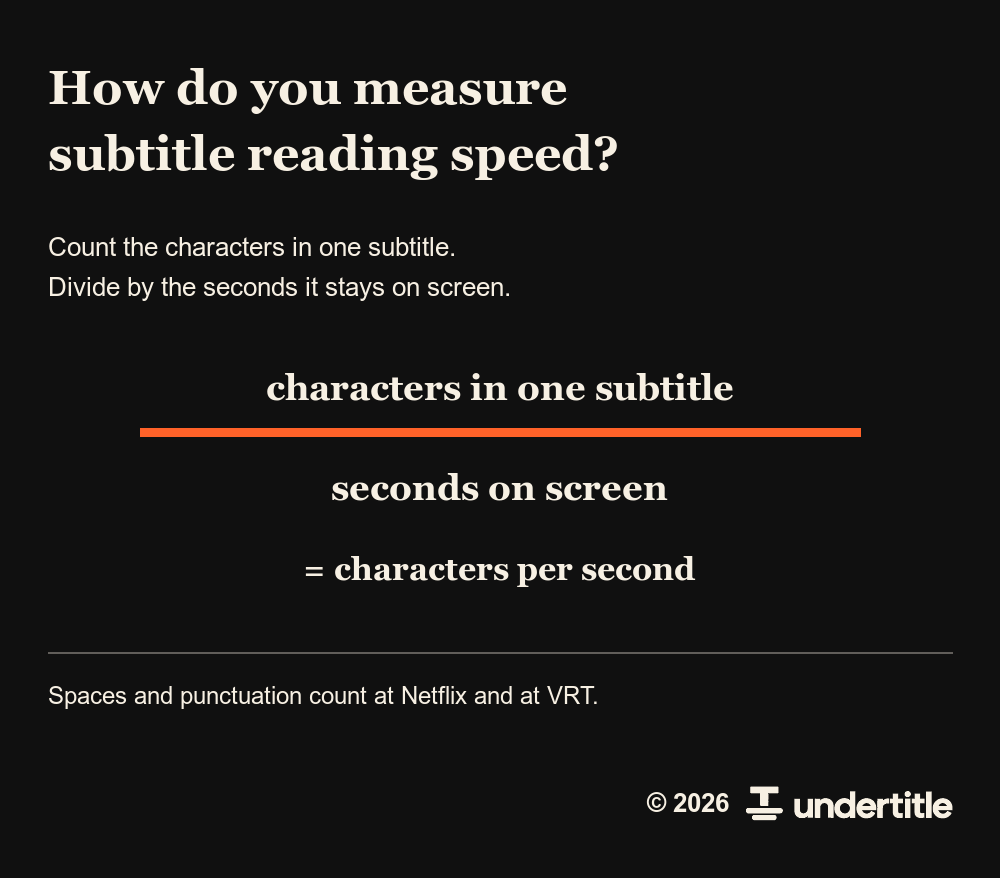
Reading speed is the number of characters in one subtitle divided by the seconds it stays on screen. The result is written as characters per second.
The counting rule matters. Netflix counts spaces and punctuation, and it measures each subtitle as well as the file average, as its help article How is reading speed measured? Do punctuation and spaces count? explains. VRT, the Flemish public broadcaster, also counts spaces and punctuation in section 8 of its Normen en instructies voor open ondertiteling.
A transcript has no display time, so it has no reading speed. A subtitle does. We cover that difference in A transcript is not a subtitle.
Some documents count words instead of characters. The BBC Subtitle Guidelines give a rate in words per minute. So did the Ofcom Code on Television Access Services of January 2017, and so does European Broadcasting Union Information I44 from 2004. The European Broadcasting Union subtitle file format can even store an intended rate in words per minute, as an optional field defined in Tech 3350 (EBU-TT Part 1).
Why does a words-per-minute figure not convert cleanly between languages?
Words are not the same length in every language. Jan Pedersen writes that an English word averages five characters, a figure he cites from Romero Fresco (2011), while a Swedish word is closer to six, in The FAR model: assessing quality in interlingual subtitling, published in The Journal of Specialised Translation. He writes that characters per second brings an issue of conversion, and that this five-versus-six gap is a trifling one next to differences in how fast people read and how fast dialogue is set.
SUBTLE, the United Kingdom subtitlers' association, puts both units next to each other in its Recommended Quality Criteria for Subtitling. It recommends an average of 12 to 15 characters per second, or 150 to 180 words per minute. That pairing is the association's recommendation. It is not a conversion formula.
If a client specification is in words per minute and you deliver in several languages, ask for the characters-per-second figure per language.
What did the research actually measure?
Two research texts answer this question in different ways. They also measure different things.
| Research text | Speed | What it reports |
|---|---|---|
| Jan Pedersen, The FAR model: assessing quality in interlingual subtitling | 12 characters per second | Viewers should keep to this speed if they are to spend less than half of their attention on the subtitles. Pedersen reports this from Romero Fresco's eye-tracking studies (2015). |
| Jan Pedersen, same article | 15 characters per second | Viewers spend on average about two thirds of their time in the subtitle area. |
| Jan Pedersen, same article | 16.5 characters per second | Viewers spend 80 percent of their time reading subtitles. |
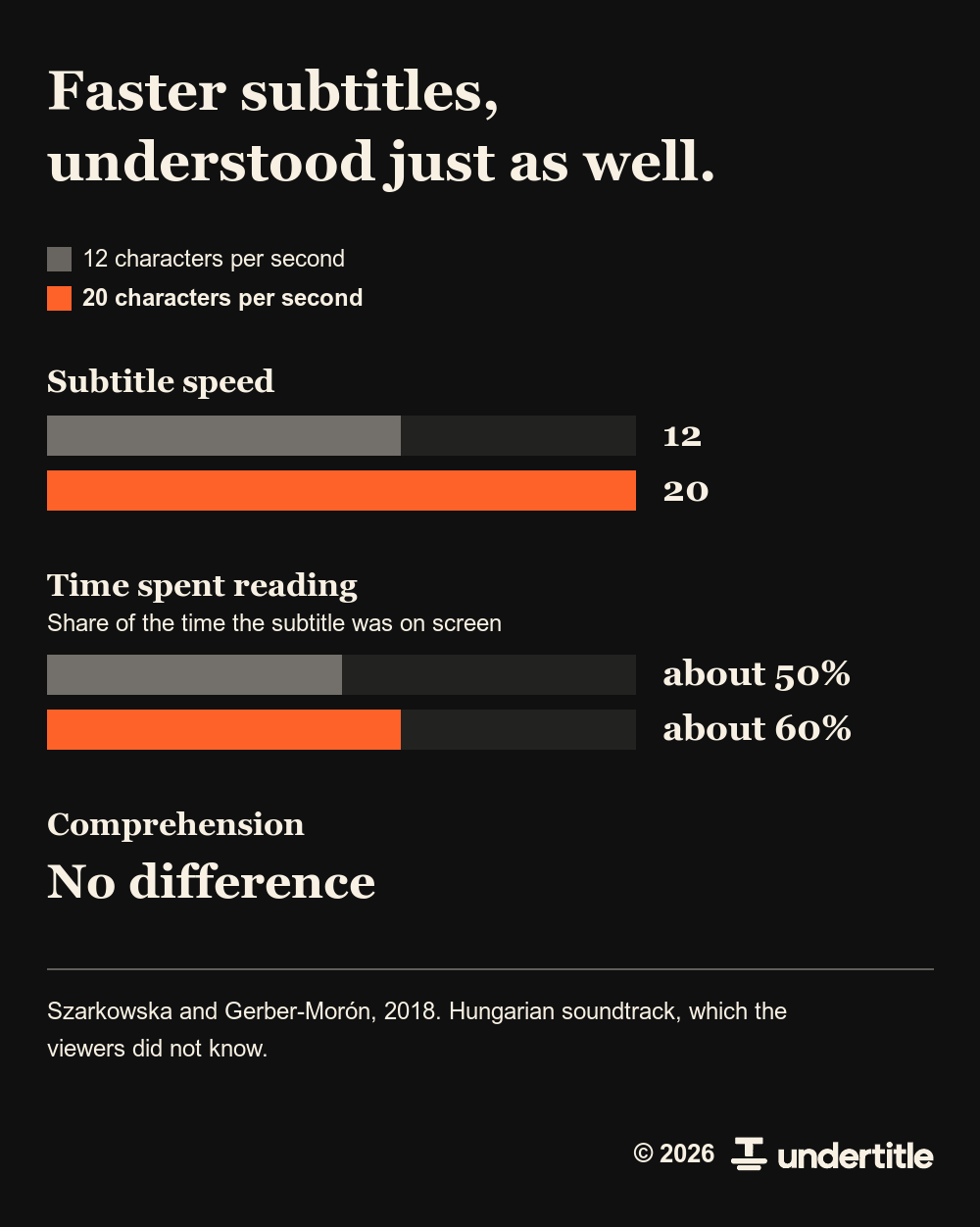
| Agnieszka Szarkowska and Olivia Gerber-Morón, Viewers can keep up with fast subtitles: Evidence from eye movements (PLOS ONE, 2018) | 12, 16, and 20 characters per second, soundtrack in Hungarian, a language the viewers did not know | Viewers spent about 50, 55, and 60 percent of the subtitle's display time reading it. |
| Szarkowska and Gerber-Morón, same study | 12 and 20 characters per second, English soundtrack | About 40 percent at 12 and about 45 percent at 20. |
| Szarkowska and Gerber-Morón, same study | 12, 16, and 20 characters per second | Speed did not affect comprehension. |
Pedersen's sentences on 15 and 16.5 characters per second do not name the study behind the figures. The 80 percent is his wording.
Do not average the two texts. Pedersen writes about a share of the viewer's time. Szarkowska and Gerber-Morón measured a share of the time each subtitle was on screen. Their percentages are also lower than his 80 percent figure.
The 2018 study had 74 English, Polish, and Spanish viewers, aged 19 to 42. They were recruited from a university volunteer pool, social media, and personal contacts, not a broadcast audience panel. They watched dialogue-heavy clips of about four to six minutes. The same clips were used at every speed, so the slower versions were more condensed.
What does a fast subtitle do to looking and understanding?
The two texts give different answers.
Pedersen writes, in The FAR model: assessing quality in interlingual subtitling, that at 16.5 characters per second, when viewers spend 80 percent of their time reading subtitles, very little attention is left for the action in a feature film. Viewers then have to choose between the subtitles and the action. He cites other authors for viewers who give some subtitles a miss, and for viewers who stop reading halfway through one. He also writes that a high share of time in the subtitle area is less of a problem for interviews or news than for a feature film.
Szarkowska and Gerber-Morón found, in Viewers can keep up with fast subtitles: Evidence from eye movements, that speed did not change comprehension. With fast subtitles, people generally spent about half their time on the subtitles and could use the rest for the picture. Scene recognition did not drop with speed. Enjoyment did not drop with speed when the soundtrack was Hungarian. When the soundtrack was English, enjoyment was generally higher with the faster subtitles. In the Hungarian-soundtrack experiment, slow subtitles were re-read about two times out of three, and fast subtitles about one time in five. Absolute reading time was longest at 12 characters per second.
Key point
A fast subtitle takes time away from the picture. How much that costs the viewer is not settled. Pedersen writes that at 16.5 characters per second viewers must choose between subtitles and action. Szarkowska and Gerber-Morón found no loss of comprehension at 20 characters per second.
Source: The FAR model: assessing quality in interlingual subtitling; Viewers can keep up with fast subtitles: Evidence from eye movements
What limits do broadcasters and platforms publish?
Each figure below belongs to the document that states it. The unit also differs. Some documents count characters, others count words, and one gives seconds per row.
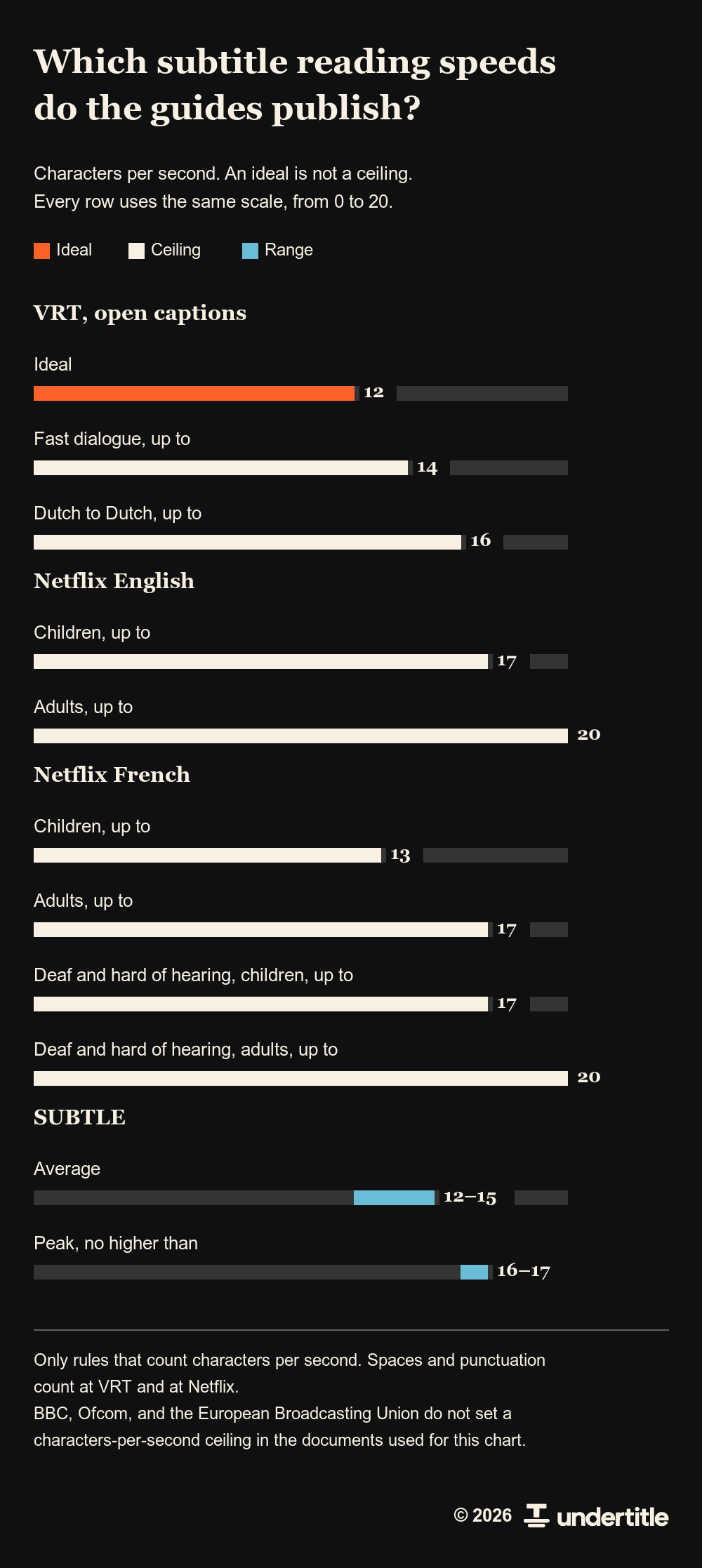
Words per minute are not on this scale. BBC, Ofcom, and the European Broadcasting Union do not set a characters-per-second ceiling in the documents cited here.
| Document | Unit | What it sets |
|---|---|---|
| VRT, Normen en instructies voor open ondertiteling, section 8 | Characters per second | Ideal of 12, spaces and punctuation included. Fast dialogue up to 14; above that, rephrase or shorten. Dutch-to-Dutch subtitles up to 16. |
| BBC Subtitle Guidelines | Words per minute | 160 to 180 words per minute, or 0.33 to 0.375 seconds per word. No characters-per-second limit. |
| Ofcom, Guidelines on Providing Television and On-Demand Access Services (current) | None | Subtitles should stay on screen long enough to be read. No words-per-minute ceiling. |
| Ofcom, Code on Television Access Services, January 2017, paragraph A1.19 | Words per minute | Pre-recorded subtitles should not normally exceed 160 to 180 words per minute. Dialogue needing more than 200 would be difficult for many viewers. |
| Netflix, English (USA) Timed Text Style Guide | Characters per second | Adult titles up to 20. Children's titles up to 17. |
| Netflix, French (France) Timed Text Style Guide | Characters per second | Adult titles up to 17. Children's titles up to 13. Subtitles for deaf and hard-of-hearing viewers may go up to 20 for adult titles and 17 for children's titles. |
| SUBTLE, Recommended Quality Criteria for Subtitling | Both | Average of 12 to 15 characters per second, or 150 to 180 words per minute. Peaks no higher than 16 to 17 characters per second, or 190 to 200 words per minute. |
| European Broadcasting Union Information I44, June 2004 | Seconds per row and words per minute | Typical display time of 2 to 3.5 seconds per single row, or not more than 140 words per minute, depending on genre. Live subtitles may change faster, up to 200 words a minute. |
Key point
No single reading speed fits every subtitle. The published figures that count characters run from 12 to 20 characters per second, and each one belongs to a language, an audience, and a type of show.
A few things in that table are easy to misread.
Netflix's "up to" is a ceiling, not a target that every subtitle must hit. For adult English titles, that ceiling is 20 characters per second, not 17. Seventeen is the limit for English children's titles and for adult French interlingual titles. If a specification quotes 17 for adult English Netflix deliveries, check it against the current English (USA) Timed Text Style Guide.
None of the European Broadcasting Union documents cited here sets a characters-per-second ceiling. Information I44 reports typical practice among broadcasters in 2004. Tech 3350 (EBU-TT Part 1) only lets a file record an intended rate in words per minute.
Ofcom's current guidelines do not repeat the 160 to 180 words per minute of the January 2017 code. They ask for subtitles that stay long enough to be read, without a number.
Market practice is wide as well. In a 2016 survey of professional subtitlers, the SURE survey report, Part 1: Subtitlers, respondents reported required rates from 10 to 24 characters per second. The most frequent were 10, 12, 15, 16, and 17. Several said some clients set no maximum at all.
How does a house style set its own target?
A house style is the written set of subtitle rules your team delivers against, whether you wrote it or your client did. The documents above point to three things that move the target.
Language. Netflix sets the limit separately in each language guide and treats it as strict, as its help article How strict are the reading speed rules? says. Because word length differs by language, as Jan Pedersen notes in The FAR model: assessing quality in interlingual subtitling, a words-per-minute rule still needs a characters-per-second figure per language. VRT allows 16 characters per second for Dutch-to-Dutch subtitles, against 14 for fast dialogue in translated subtitles, in its Normen en instructies voor open ondertiteling.
Audience. Netflix sets lower limits for children's titles in both the English (USA) and French (France) guides. Ofcom's current Guidelines on Providing Television and On-Demand Access Services say young children may read more slowly than adults. They also ask providers to consider slower readers, including some people whose first language is British Sign Language and some people with cognitive conditions. VRT warns against too many fast subtitles in a row, because that makes it too hard for viewers, including older viewers and slower readers.
Genre. The BBC Subtitle Guidelines say news, current affairs, and most other genres should be verbatim up to around 160 to 180 words per minute, with some editing expected above that. Ofcom names comedy punchlines, quiz shows, fast chat shows, sport, news, and emergency announcements as cases where sync, editing, or delay trade off differently. European Broadcasting Union Information I44 says typical display times depend on genre.
Write down the answers to these questions before the first delivery:
- Do you count in characters per second or words per minute, and do spaces and punctuation count?
- What is the limit for each language you deliver?
- Is there a lower limit for children's titles?
- Which genres get their own limit or allow more editing?
- Does the limit apply to each subtitle, to the file average, or to both?
- What should the subtitler do when a subtitle goes over?
How do you check subtitles against the target?
Check each subtitle and the file average. Netflix measures both, according to How is reading speed measured? Do punctuation and spaces count? Netflix tells translators to stay inside the limit and to use the reading-speed warnings in its Originator software, in How strict are the reading speed rules?
Fix a fast subtitle by condensing it. The English (USA) Timed Text Style Guide favours reducing, deleting, and condensing text, and limits truncation to cases where reading speed or sync is a problem. VRT asks the subtitler to rephrase or shorten, but not to write clumsy or telegram-style Dutch just to reach the ideal, in its Normen en instructies voor open ondertiteling. VRT also puts reading time ahead of a shot change when the subtitle would otherwise be hard to read.
Allow for what makes a subtitle harder to read. In its Recommended Quality Criteria for Subtitling, SUBTLE gives extra time for very short subtitles, complex syntax and vocabulary, a sudden change of position or format, and low contrast. It avoids subtitles shorter than 1 second where possible, and keeps the maximum at 6 seconds, with exceptions such as song lyrics.
Treat a warning as a prompt for an editor, not as the verdict. The BBC Subtitle Guidelines say timing is an editorial decision, and that judging only by the number of words on screen would be an unacceptably crude approach. BBC research also questions a fixed rate. With sound and lip-reading available, BBC Research and Development White Paper WHP 306, The Impact of Subtitle Display Rate on Enjoyment Under Normal Television Viewing Conditions, found an optimum of 171 words per minute for scrolling subtitles and 177 for block subtitles. The point where most subtitle users in that study would find subtitles too fast was 227 words per minute for scrolling and 242 for block. The BBC Research and Development article How fast should subtitles be? concludes that guidelines should not tell subtitlers to edit to a specific rate.
Frequently asked questions
01
What is a good reading speed for subtitles?
There is no single figure. VRT, the Flemish public broadcaster, sets an ideal of 12 characters per second and a maximum of 14 for fast dialogue in its Normen en instructies voor open ondertiteling. Netflix allows up to 20 characters per second for adult titles in its English (USA) Timed Text Style Guide and up to 17 for adult titles in its French (France) Timed Text Style Guide. The subtitlers' association SUBTLE recommends an average of 12 to 15 characters per second, with peaks no higher than 16 to 17, in its Recommended Quality Criteria for Subtitling. Choose the figure by language, audience, and genre, and write it into your house style.
02
Does Netflix limit adult English subtitles to 17 characters per second?
No. The English (USA) Timed Text Style Guide sets reading speed limits of up to 20 characters per second for adult titles and up to 17 for children's titles. Seventeen is the adult limit for French interlingual subtitles in the French (France) Timed Text Style Guide, where children's titles go up to 13. If a specification quotes 17 for adult English Netflix deliveries, check it against the current English guide.
03
Does the European Broadcasting Union set a characters-per-second limit?
None of the European Broadcasting Union documents cited in this guide sets one. European Broadcasting Union Information I44 (June 2004) reports typical display times of 2 to 3.5 seconds per single row, or not more than 140 words per minute, and says this depends on genre. The subtitle file format described in Tech 3350 (EBU-TT Part 1) only defines an optional field that records an intended reading speed in words per minute.
04
Do spaces and punctuation count toward characters per second?
At Netflix and at VRT, yes. Netflix counts spaces and punctuation, and measures each subtitle as well as the file average, according to How is reading speed measured? Do punctuation and spaces count? For character-based languages, Netflix counts punctuation and Latin characters written as single-byte characters as half a character, unless that language's style guide says otherwise. VRT's 12 characters-per-second ideal also includes spaces and punctuation, in section 8 of its Normen en instructies voor open ondertiteling.
05
Can I convert words per minute into characters per second?
Not with one fixed ratio. Words are longer in some languages than in others. Jan Pedersen writes that an English word averages five characters, a figure he cites from Romero Fresco (2011), and that a Swedish word is closer to six, in The FAR model: assessing quality in interlingual subtitling. SUBTLE lists both units side by side in its Recommended Quality Criteria for Subtitling, for example an average of 12 to 15 characters per second or 150 to 180 words per minute. That pairing is the association's recommendation, not a formula. Set a characters-per-second figure for each language you deliver.
Book a free demo
Want to see how Undertitle turns English shows and films into Dutch subtitles? We will walk through it with you.