In short
Since 28 June 2025, Member States have been required to apply the European Accessibility Act to the services people in the European Union use to find and watch television and on-demand programmes. For subtitles, it asks four things: they arrive in full, display accurately, stay in sync, and stay under the viewer's control. It sets no reading-speed limit, no accuracy score, and no file format. How many programmes need subtitles is still decided by national rules.
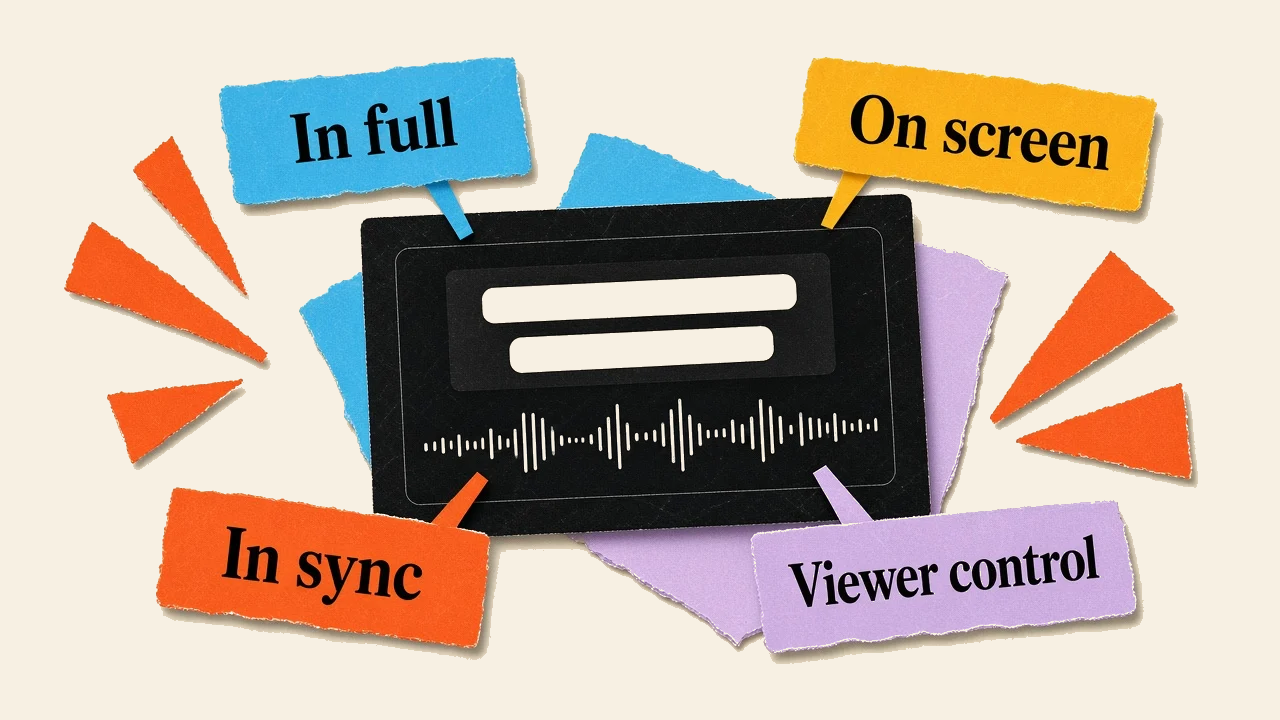
To comply with the European Accessibility Act, your subtitles must reach the viewer in full and display correctly. They must also stay in sync with sound and picture, and viewers must be able to control them. These rules apply to the services people in the European Union use to watch television and on-demand programmes.
The European Accessibility Act does not decide how many of your programmes need subtitles. A different law of the European Union, and your national rules under it, do that. This guide covers both.
The European Accessibility Act (EAA) is Directive (EU) 2019/882, adopted on 17 April 2019. Each Member State had to turn it into national law. The directive requires Member States to apply those measures from 28 June 2025 (Article 2 and Article 31(2)).
The legal points below come from the official texts. The practical review steps and the checklist are a way to organise the work, not text from those sources. Where the official texts are silent, we say so.
Who has to comply?
You are covered if you run a service that lets consumers find, select, and watch television broadcasts or on-demand programmes.
The law calls these "services providing access to audiovisual media services". In practice, that can mean your website, your apps, your set-top box app, your connected television app, and your media player. Electronic programme guides are named explicitly. (Article 3(6) and recital 31 of Directive (EU) 2019/882.)
Devices are covered too. Consumer equipment with interactive computing capability, used to watch these services, must pass your subtitles on and let viewers select and personalise them. (Article 2(1)(d) and Annex I, Section I.) The European Commission's overview of the European Accessibility Act lists television equipment related to digital television services.
What counts as a television or on-demand service is defined in another law: the Audiovisual Media Services Directive (AVMSD), Directive 2010/13/EU. It covers programmes under a provider's editorial responsibility. (Article 1(1) of the Audiovisual Media Services Directive.) Video-sharing platforms are a separate category in that directive. The European Accessibility Act's definition does not point to that category.
If you are unsure which category your service falls into, the answer sits in the Audiovisual Media Services Directive, not the European Accessibility Act.
Are there exceptions?
Very small service providers are exempt. A microenterprise has fewer than 10 staff and an annual turnover or balance sheet total of no more than €2 million. (Article 3(23) and Article 4(5) of Directive (EU) 2019/882.)
Other providers can do less only if full compliance would fundamentally alter the service or impose a disproportionate burden. (Article 14.)
If you rely on that exception, write the assessment down and keep it for five years after the service was last provided. Renew it, only when you rely on disproportionate burden and not on fundamental alteration alone, when you change the service, when an authority asks, and at least every five years.
Lack of priority, time, or knowledge does not count as a reason. (Recital 66.) If you receive funding meant to improve accessibility, you cannot claim disproportionate burden. (Article 14(6).)
What does the European Accessibility Act ask of your subtitles?
The European Accessibility Act asks four things of your subtitles. Here is each one in the law's words, with what it means day to day:
- Fully transmitted. The complete subtitle track reaches the viewer.
- Adequate quality for accurate display. The subtitles show correctly on the viewer's screen.
- Synchronised with sound and video. Each subtitle appears with the speech or sound it belongs to.
- Under the viewer's control. Viewers can control how subtitles are displayed and used.
The same four rules apply to audio description, spoken subtitles, and sign language interpretation. (Annex I, Section IV(b)(ii) of Directive (EU) 2019/882.)
Your electronic programme guide has a rule of its own. It must be perceivable, operable, understandable, and robust. It must also show which programmes come with accessibility features. (Annex I, Section IV(b).)
Timing deserves extra attention. A clean, accurate transcript can still fail the sync rule. We explain why in A transcript is not a subtitle.
Note
All four rules are about what reaches the viewer. A good subtitle file that arrives incomplete or out of sync does not meet them.
What does the European Accessibility Act leave out?
The European Accessibility Act sets no characters-per-second (CPS) limit, no accuracy percentage, and no required file format. We read Articles 2 to 4 and Annex I of Directive (EU) 2019/882, where the rules for services sit, and found none of these.
Some consultancy websites add figures of their own. Includio's guide, What the European Accessibility Act Means for Broadcasters and Streaming Platforms, cites EN 301 549 clause 7.3. It also points to the Web Content Accessibility Guidelines (WCAG) 2.1 at level AA. The Digital Accessibility Centre's page on audiovisual media and television requirements gives a 0.7° viewing angle for captions. Those are the consultancies' readings. None of these figures is named in the European Accessibility Act's own text.
The directive also contains a list of examples, Annex II. One says viewers should be able to switch on access services with the same prominence as the main playback controls. Annex II is labelled non-binding, so treat that example as good practice, not as a duty.
Your house style or a client's delivery specification may still set a reading speed or a format. That is a quality or contract choice. It is not a requirement of the European Accessibility Act.
Is there a standard you can follow?
There is one candidate, and following it is voluntary. It is EN 301 549 V4.1.1, a European standard from the European Telecommunications Standards Institute (ETSI).
The European Telecommunications Standards Institute prepared it at the European Commission's request as one voluntary way to meet the European Accessibility Act. (Standardisation request C(2022) 6456 final.)
Once the standard is cited in the Official Journal of the European Union, its relevant clauses give a "presumption of conformity". In plain terms, you are presumed to meet the requirements that the standard covers. (Article 15(1) of Directive (EU) 2019/882.)
We could not confirm whether that Official Journal citation has been published. Check its status before you rely on it.
Who decides how many programmes need subtitles?
Your national rules decide, not the European Accessibility Act. Those rules come from the Audiovisual Media Services Directive. It asks each Member State to make television and on-demand services continuously and progressively more accessible, through proportionate measures. (Article 7 of the Audiovisual Media Services Directive.)
The Audiovisual Media Services Directive sets no percentage of subtitled programmes for the whole European Union. Each country chooses its own approach.
The European Accessibility Act then sets how those subtitles must reach the viewer. Its rules apply to the subtitles that result from the national measures under the Audiovisual Media Services Directive. (Article 3(6) of Directive (EU) 2019/882.)
A European Commission report covering 2019 to 2022 counted what Member States reported:
| What Member States reported, 2019 to 2022 | Number of Member States |
|---|---|
| A required proportion of programmes with accessibility features, such as subtitles | 13 |
| Specific accessibility rules for on-demand services | 13 |
| Of those, specific quotas for accessible on-demand content | 5 |
| Providers reported to their national regulator | 14 |
| Accessibility action plans developed | 10 |
Source: Commission Staff Working Document SWD(2024) 4 final, section 2.4. The report does not publish each country's percentages.
The same report points to a few patterns. Public broadcasters tend to face higher proportions than private ones. Several countries set stricter rules for news, political and economic debates, and services of general interest. Some exempt certain programme types, such as thematic channels for live music and sports. Some exempt very small providers.
The European Parliament wants common targets across the European Union, including a percentage of accessible content. It asked for this in its resolution of 9 May 2023 on the implementation of the revised Audiovisual Media Services Directive (P9_TA(2023)0134). The resolution does not set a percentage itself.
Key point
The European Accessibility Act decides how subtitles must reach the viewer. Your country's rules under the Audiovisual Media Services Directive decide how many programmes need them.
Which dates matter?
The date that matters most is 28 June 2025. From that day, the directive requires Member States to apply their measures to services provided to consumers and to products placed on the market. (Article 2 and Article 31(2) of Directive (EU) 2019/882.)
| Date | What it means |
|---|---|
| 28 June 2022 | Deadline for Member States to adopt and publish their national laws under the European Accessibility Act |
| 28 June 2025 | Member States must apply their measures under the European Accessibility Act |
Both dates come from Article 2 and Article 31 of the directive.
You may see 28 July 2025 in a Commission staff report, SWD(2024) 4 final. The directive itself says 28 June 2025. Go with the directive.
What about content published before June 2025?
Some older website and app content is excluded. But the European Accessibility Act sets no separate deadline for subtitling a back catalogue.
The exclusion applies to content on websites and in mobile apps. It covers, among other things (Article 2(4) of Directive (EU) 2019/882):
- pre-recorded time-based media published before 28 June 2025
- office file formats published before 28 June 2025
- archives that only hold content not updated or edited after 28 June 2025
- third-party content that you did not fund, develop, or control
Whether a given title falls under the exclusion depends on where and how you publish it. Check specific cases with your counsel or regulator.
What happens if you get it wrong?
Each Member State sets its own penalties. The European Accessibility Act does not name a euro amount.
National penalties must be effective, proportionate, and dissuasive, and must come with remedial action. Authorities look at how serious the failure is, how many products or services fall short, and how many people are affected. (Article 30 of Directive (EU) 2019/882.)
There is a paperwork duty as well. Service providers must publish how their service meets the accessibility requirements, in written and oral form that people with disabilities can use. The general terms and conditions, or an equivalent document, is where this goes. (Article 13 and Annex V.)
How do you keep up without tripling your team?
Let speech recognition produce the first draft, then have editors check and correct it before release. Editors then spend their time reviewing instead of typing from scratch.
The European Accessibility Act neither requires nor forbids any method. What counts is that the result meets the four rules. The Commission's report on the Audiovisual Media Services Directive is SWD(2024) 4 final. It notes that several Member States reported successful use of speech recognition and subtitling technologies.
A workable review flow has five steps:
- Draft. Speech recognition produces timed subtitles.
- Edit. An editor fixes words, names, and line breaks, and adds the sound cues your house style asks for.
- Check timing. Play the video back and confirm each subtitle lands with its speech.
- Check delivery. Confirm the full track plays in each app and on each device, and that viewers can switch it on and adjust it.
- Keep a record. Log what was checked and when. That internal log is not the report. Beside it, under Article 7(2) of the Audiovisual Media Services Directive, media service providers report regularly to their national regulatory authority or body.
Undertitle can support and speed up this whole process. That way you work efficiently and keep costs down.
Put your most careful review where the rules are strictest. Several countries set a higher bar for news and political debates.
The official sources give no figure for review hours or for how many editors a given volume needs. Measure your own before you plan headcount.
What should be on your checklist?
Use this list for a first audit of one channel or app:
- Every place viewers watch your programmes is mapped: website, apps, connected television, set-top box, and electronic programme guide.
- The full subtitle track reaches each of those players.
- Subtitles display correctly on your main devices.
- Subtitles stay in sync after transcoding, editing, or when advertising breaks are inserted.
- Viewers can switch subtitles on and off and adjust how they look.
- Your electronic programme guide shows which programmes have subtitles.
- Your accessibility information is published.
- You know your country's rules on how many programmes need subtitles.
- If you rely on the burden exception, the assessment is written down and dated.
A sensible next step is to run this list on your busiest channel or app first. Note where subtitles fail and how long review takes per hour of video. Those two numbers show where a draft-and-review workflow would save the most time.
Frequently asked questions
01
Does the European Accessibility Act set a reading speed or accuracy target for subtitles?
No. Annex I, Section IV(b)(ii) of Directive (EU) 2019/882 requires subtitles to be fully transmitted, of adequate quality for accurate display, synchronised with sound and video, and under the viewer's control. Articles 2 to 4 and Annex I set no characters-per-second (CPS) limit and no accuracy percentage. A house style or client specification may still set those figures, but they are not rules of the European Accessibility Act.
02
Does the European Accessibility Act require a specific subtitle file format?
No. Directive (EU) 2019/882 does not name a required format such as SubRip (SRT), Timed Text Markup Language (TTML), or European Broadcasting Union Timed Text (EBU-TT). It asks that subtitles reach the viewer in full and in sync. The European standard EN 301 549 V4.1.1 is one voluntary way to meet the European Accessibility Act. It gives a presumption of conformity only once it is cited in the Official Journal of the European Union.
03
When did the European Accessibility Act start to apply?
Member States must apply the measures from 28 June 2025, under Article 2 and Article 31(2) of Directive (EU) 2019/882. One paragraph of the Commission staff working document SWD(2024) 4 final prints 28 July 2025, but the date in the directive is 28 June 2025. Products lawfully used to provide similar services before 28 June 2030 may stay in use until that date (Article 32(1)). Recital 101 is separate: products placed on the market before 28 June 2025 need not comply unless they are replaced. Service contracts agreed before 28 June 2025 can run until they expire, for no more than five years from that date (Article 32).
04
Are small broadcasters or streamers exempt from the European Accessibility Act?
Microenterprises that provide services are exempt from the service requirements, which include the subtitle rule (Article 4(5) of Directive (EU) 2019/882). A microenterprise employs fewer than 10 people and has an annual turnover or balance sheet total of no more than €2 million (Article 3(23)). Larger providers can scale back only if full compliance would fundamentally alter the service or impose a disproportionate burden. They must document that assessment and keep it for five years after the service was last provided (Article 14). Renewal when the service changes, when an authority asks, and at least every five years applies when the provider relies on disproportionate burden, not on fundamental alteration alone.
05
Does the European Accessibility Act say how many programmes must have subtitles?
No. That number comes from national rules under the Audiovisual Media Services Directive (AVMSD), Directive 2010/13/EU. Article 7 of the Audiovisual Media Services Directive asks for continuous and progressive improvement through proportionate measures and sets no percentage for the whole European Union. A Commission report covering 2019 to 2022, SWD(2024) 4 final, section 2.4, found that 13 Member States had rules on the proportion of programmes with accessibility features, and 5 had quotas for accessible on-demand content. The European Parliament asked for a common percentage in its resolution of 9 May 2023 but did not set one.
Book a free demo
Want to see how Undertitle turns English shows and films into Dutch subtitles? We will walk through it with you.